BOM-driven manufacturing
Define the required components and quantities for each product. The BOM provides the controlled foundation for the manufacturing process, ensuring that every order starts from a consistent, standardized specification.
BOM-driven production orders, automated material picking, real-time buildable quantity calculations, and end-to-end traceability from components to uniquely identified finished goods.
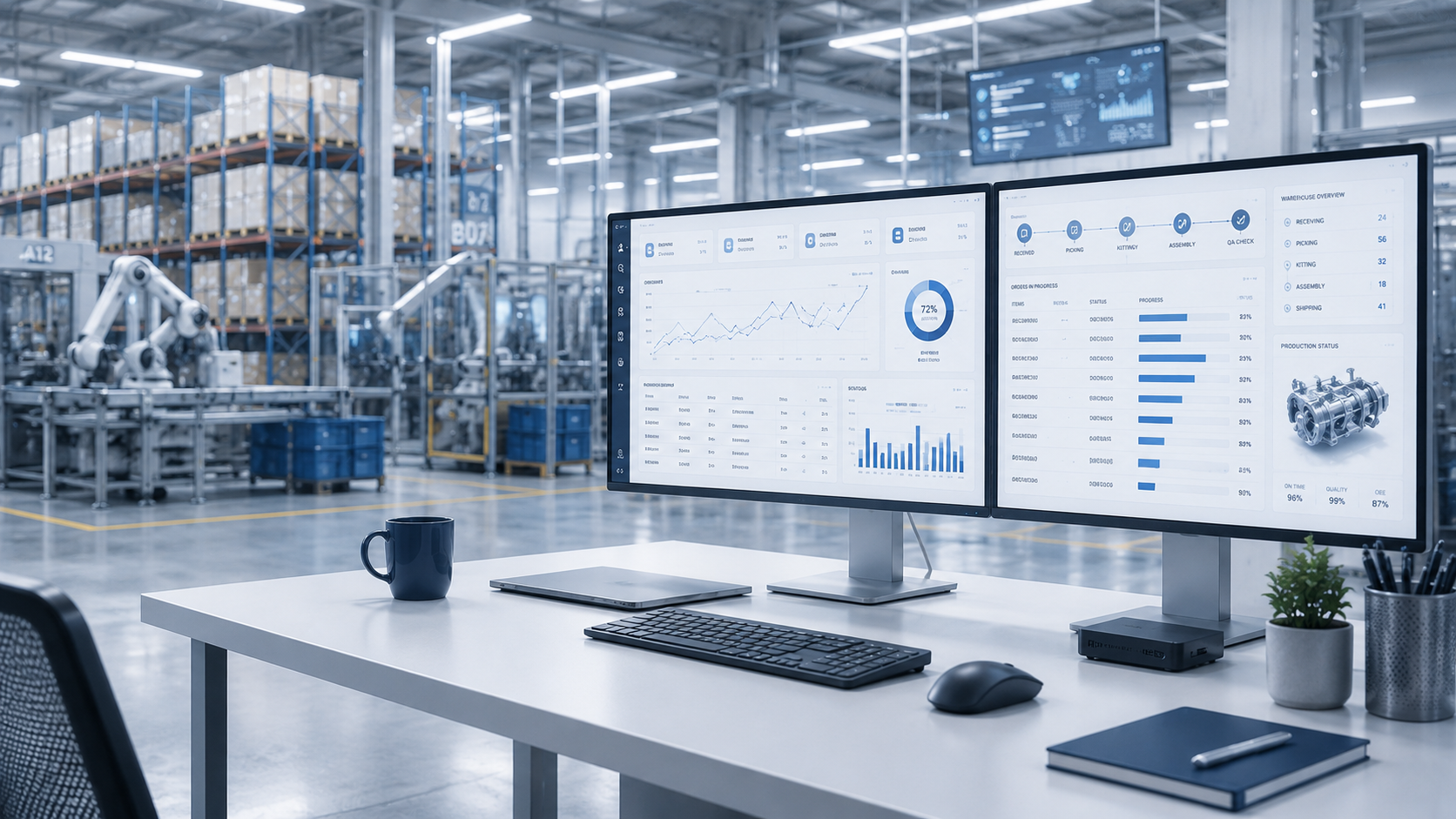
Manufacturing and assembly processes often begin directly in the warehouse. FlexPortals WMS connects the bill of materials, available inventory, picking, production execution, and finished goods receipt.
When a production order is created, the system automatically generates the required component list from the product's bill of materials (BOM), organizes material staging at the production location, and determines how many finished units can be produced at that moment based on actual inventory availability.
At the end of the process, the system receives the finished goods into inventory and deducts the components actually consumed. All related lot, serial number, and event data is retained throughout and remains fully searchable.
The capabilities cover the entire manufacturing process, from the BOM through finished goods receipt.
Define the required components and quantities for each product. The BOM provides the controlled foundation for the manufacturing process, ensuring that every order starts from a consistent, standardized specification.
Track production orders from planning through work in progress to closure. Component requirements can be adjusted or supplemented within the order whenever necessary.
The system automatically creates picking or internal transfer tasks for the required components, ensuring that materials are available in the right quantity and at the right location.
FlexPortals WMS continuously calculates the quantity of finished goods that can currently be produced from the component inventory actually on hand.
For each component, you can specify the lot- or serial-controlled inventory that may be consumed. Finished goods can receive their own identifier, while the system logs all related picking and inventory movement events.
If the full planned quantity is not produced, the production order can be closed with a recorded reason. The system continues to manage any unused components that have already been staged in a controlled manner.
When a production order is created, FlexPortals WMS does more than record a task. Based on the BOM, the system generates the order-specific component requirements, matches them against current inventory, organizes material picking, and supports the controlled receipt of finished goods.
When the product to be manufactured is selected, the system automatically generates a list of the materials and components required for that specific order.
Specific manufacturing scenarios can be accommodated: the component list can be supplemented or modified within each production order as needed.
For components not yet available at the production location, the system generates picking or internal transfer tasks and supports their movement to the production location.
The system shows more than the planned quantity: it uses actual inventory to determine how many finished units can be produced at that moment.
The system receives the quantity actually produced into finished goods inventory and deducts the components consumed accordingly.
If the full planned quantity is not produced, the production order can be closed with a recorded reason. The system also manages any unused inventory that has already been staged in a controlled manner.
In manufacturing, inventory quantities alone are not enough. You may also need to know exactly which material batch, lot, or serialized component was used in a product.
For each component, FlexPortals WMS can specify which uniquely identified inventory may be consumed. The system records the lots used, the associated picking events, and the identifiers assigned to the resulting finished goods.
The manufacturing capabilities of FlexPortals WMS use the same inventory, picking, and traceability mechanisms that support day-to-day warehouse operations.
The system handles component consumption and finished goods receipt through standard warehouse inventory movements.
Materials required for manufacturing can be staged and moved to the production location through existing WMS workflows.
Component and finished goods identifiers are retained throughout the process and remain fully searchable.
Production orders can be linked to customers, supporting make-to-order manufacturing processes.
The bill of materials can also be generated as a document from a template.
All related inventory, picking, and manufacturing events remain searchable.
A wide range of specialized software is available for production equipment and manufacturing lines, often supplied directly by the equipment manufacturer. These solutions are closely tailored to the equipment they support and typically handle technology-specific tasks in far greater depth than a general-purpose warehouse management system.
FlexPortals WMS focuses on the processes that connect manufacturing with warehousing and logistics. It manages material requirements and inventory availability, supports component picking and supply to production, calculates how much can be produced, records material consumption and finished goods receipts, and provides lot-level traceability.
If a project requires closer interaction between production equipment and FlexPortals WMS, we integrate FlexPortals WMS with the existing machine control or production management system.
If no suitable specialized software adequately supports the process, we can develop project-specific MES functionality based on requirements defined jointly with the customer.
A product-specific list of components and quantities that provides the foundation for manufacturing.
A manufacturing workflow that can be tracked from planning through closure.
The component list can be modified and supplemented for each production order.
The system automatically creates picking tasks for required components that are not yet available at the production location.
Materials are moved to the production location through existing WMS workflows.
The system continuously calculates the quantity that can currently be produced from actual inventory.
The quantity actually produced is received into warehouse inventory.
Consumed components are deducted from inventory in line with the finished goods receipt.
For each component, you can specify which uniquely identified inventory may be consumed.
Finished goods can be assigned a unique identifier during manufacturing.
All picking events associated with components are logged and remain searchable.
A production order can be closed with a recorded reason when the full planned quantity is not produced.
Production orders can be linked to customers to support make-to-order manufacturing.
The bill of materials can be exported as a document using a template.